
In many households, a moved bowl or a shared cushion can be enough to upset the balance between dogs and cats. Veterinarians observe that free-feeding for cats often attracts dogs and leads to digestive disorders.
Urinary marking, often attributed solely to cats, also concerns some dogs in situations of stress or territorial competition. Harmonious cohabitation relies on the strict application of precise rules, but also on anticipating the unexpected behaviors specific to each species.
Why Dogs and Cats Don’t Always Understand Each Other: Decoding the Differences
Misunderstandings between dogs and cats are not a matter of chance. It all starts with body language, which regularly creates misunderstandings. A dog wagging its tail often expresses friendly excitement; a cat doing the same warns of annoyance or a risk of attack. Postures also speak: the dog approaches directly, straight towards the other, driven by curiosity. The cat, on the other hand, prefers to dodge, take detours, and observe cautiously. The result: each sends signals that the other cannot read.
Territorial management adds another layer of complexity. The feline jealously defends its corners, multiplies hiding spots, and perches to keep watch. The dog, naturally social, seeks companionship and more easily accepts proximity. Often, ignorance of these needs triggers tensions. Here are the most common situations:
- an overly intrusive dog,
- a cat constantly on the defensive.
To maintain balance, it is essential to provide the cat with refuges out of the dog’s reach and to offer the latter a resting place where it will not be disturbed.
Hunting instincts and the notion of hierarchy also oppose our companions. The cat, a solitary hunter, does not like to have rules or constraints imposed on it. The dog, coming from a social organization, seeks to find its place in the family. For cohabitation to go well, one must focus on gradual adaptation and socialization from a young age. Observing each one’s reactions helps to defuse many conflicts.
The experience shared on the page Chiens et Chats, cited in the Dogs and Cats – Our Animal Friends section, shows how deeply understanding each species’ communication mode changes the game. Taking the time to study their interactions, adjusting the organization of spaces, and increasing moments of respectful exchange: this is how balance is established. Between dog and cat, harmony is built over time, with patience, discernment, and genuine attention to their particularities.
What Tips to Establish Good Relations at Home?
Having a dog and a cat coexist in the same home is not something that can be improvised. The first meeting should take place in a peaceful atmosphere, under the vigilant eye of the owner. The dog remains on a leash, while the cat moves freely. Focusing on a neutral space helps to avoid territorial rivalry from the outset. It is recommended to provide several hiding spots for the cat and to offer each animal the possibility to isolate itself if needed.
Avoid competition around meals by creating distinct feeding zones: each animal has its bowl, in a designated area. The dog must learn not to chase the cat, which should always be able to move away safely. Encourage calm exchanges, reward every peaceful interaction, and never force proximity. Allow time to work its magic: adaptation is built step by step, according to each one’s personality.
To support this delicate phase, closely monitor certain signs and adopt good reflexes:
- Identify signs of stress: growling, hissing, avoided gazes.
- Reinforce moments of tranquility with petting or a treat.
- Provide each with separate resting moments to ensure a sense of security.
If tensions persist, the intervention of a behaviorist or a dog trainer can prove valuable. Early socialization remains the simplest way to establish trust. The veterinarian, for their part, helps to detect any health issues that could explain aggression or isolation. Living together between dog and cat is built over time, thanks to attentive observation and constant adjustments.
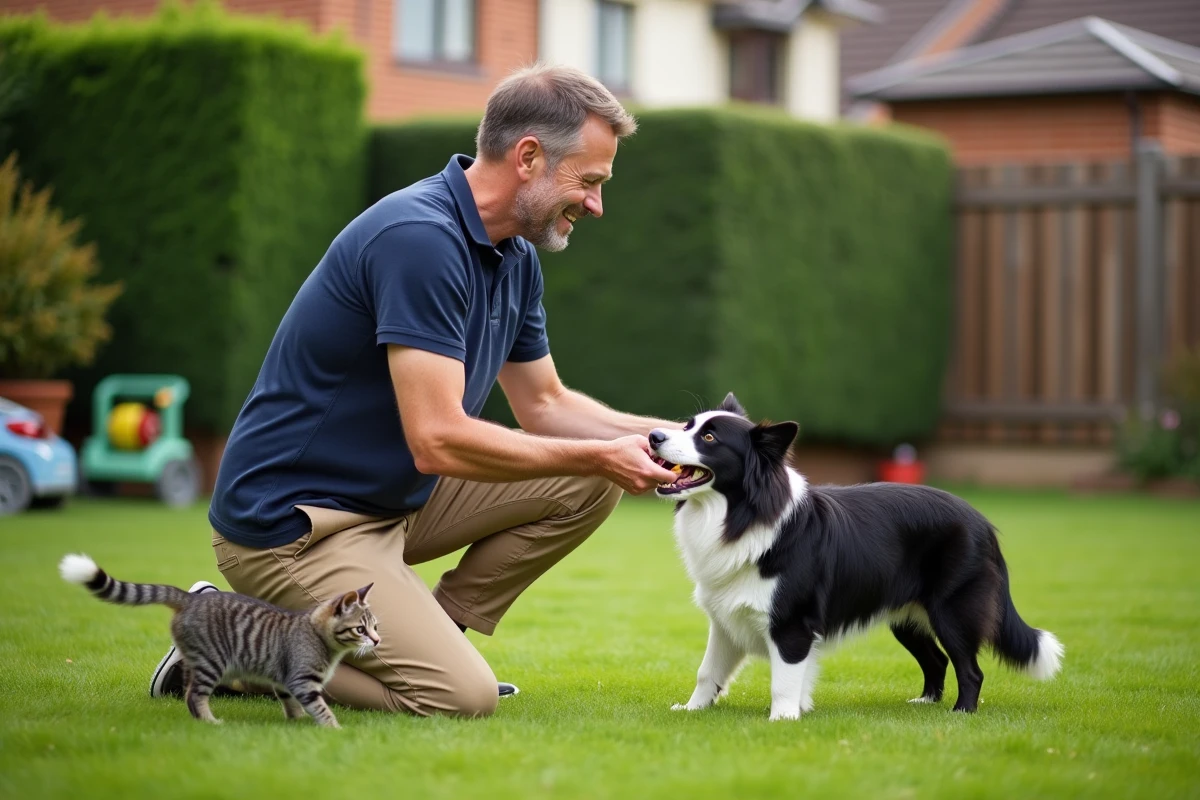
Living Together Daily: Routines, Games, and Well-Being for All
A well-established daily organization sustainably maintains the balance between dogs and cats. Fixed references reassure, limit excesses, and calm rivalries. Serve meals at regular times, in well-separated spaces. Each should have its own bowl, its quiet corner, its marked territory. For the cat, create access to heights: cat trees, shelves, tops of cabinets. The dog, on its side, appreciates a cozy bed away from traffic.
Play also occupies a central place in cohabitation. The dog requires frequent outings, stimulating walks, and sturdy, varied toys. For the cat, prioritize objects to chase, balls, scratching posts, and hiding spots. Offer positive interactions while respecting the need for solitude specific to each species. Too much inactivity fosters aggression, and frustration can exacerbate competition.
To structure the day and meet everyone’s needs, here are some activities to integrate:
- Dog: daily outings, tracking games, learning exercises.
- Cat: interactive games, high hiding spots, quiet times without solicitation.
Finally, never neglect hygiene. Change the water regularly, wash the bowls, and maintain the cat’s litter. Providing clean and suitable places ensures their tranquility and health. By varying stimuli, structuring space, and respecting each one’s rhythms, you will lay the foundations for a serene and stimulating shared life. The dog-cat harmony is created daily, through small gestures and attentive adjustments, and that is the secret to successful cohabitation.