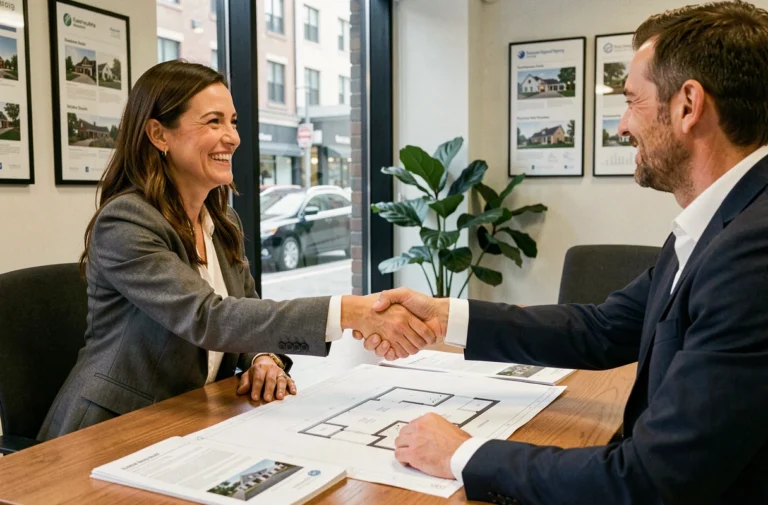
The choice of a property never guarantees the success of a real estate project. In some cases, solid financing fails due to poor anticipation of administrative procedures. Planning errors can be costly, even for experienced buyers.
From the very first visit, traps await. Negotiation spares no one. Yet, each step of the journey, from the initial budget calculations to the final signature, can be mastered. Precise and tailored advice helps avoid unpleasant surprises, refine each decision, and move forward with confidence.
What to know before embarking on a real estate project
It all starts with one thing: establishing a rigorous budget. Buying a property is a long-term commitment, sometimes for a lifetime. Borrowing capacity, income, expenses, and personal contribution determine the scope of your search. The price per m² varies greatly depending on the city, region, and market tension. In Paris, Lyon, or Bordeaux, the reality is quite different from that in an average city. Add to this a changing context: interest rates, selling timelines, local dynamics—all weigh in the balance.
For first-time buyers, the journey is impressive in its density. Every choice is crucial. Primary residence or rental investment, new or old, each option influences taxation, anticipated costs, and resale potential. The DPE (energy performance diagnosis) becomes a key data point, especially with strengthening ecological standards. An old property, appealing on paper, may hide costly repairs or a hefty energy bill.
To stay on course, it’s best to follow a clear method: clarify your objectives, plan step by step, prioritize your needs, analyze the market, consult professionals, and then negotiate. Legal obligations leave no room for improvisation: suspensive conditions, compromise, notarial deed. Regulations protect but require a methodical and foresighted approach.
To delve deeper into each step, learn more about Mon Projet Immo offers practical resources: calculation tools, financing simulators, and tailored advice for real estate purchases in France.
What pitfalls to avoid and essential steps to take?
Budgetary rigor is never superfluous. Before any action, the buyer must assess their borrowing capacity: income, expenses, amount of contribution, debt ratio. If this ratio exceeds 35%, obtaining a mortgage becomes difficult. Additional costs can accumulate quickly: notary fees, agency fees, renovation budget, borrower insurance, various guarantees. Neglecting any of these items can jeopardize the project’s viability.
The signing of the sales agreement requires extreme vigilance. This document binds both parties. It must include all suspensive conditions: loan agreement, validity of diagnostics, absence of unknown easements. The notary acts as a guarantor of proper proceedings, drafting the authentic deed and controlling the flow of funds.
Real estate purchases do not tolerate approximation. Research, negotiation, verification of the DPE, estimation of necessary renovations: each step requires careful analysis. For a first purchase, transparency and comparison are valuable allies. Multiply loan requests, compare APRs, and inquire about schemes like the PTZ or social access loans.
To leave nothing to chance, here’s what to systematically examine:
- Assess personal contribution and borrowing capacity
- Check all technical diagnostics
- Anticipate future costs and expenses
- Negotiate every item, from price to insurance
Successfully completing your real estate project requires method and foresight. It’s about adopting a critical perspective, paying attention to every detail, especially in a market where rates and rules are constantly changing.

Concrete advice to optimize every phase of your real estate purchase
At the start, clarify your ambitions: do you want to live in the property or rent it out? The strategy differs, between seeking profitability and quality of life, between potential appreciation and long-term security. The geographical area is decisive: analyze the local real estate market, compare prices per m², and find out about average selling timelines. Location remains a pillar.
To refine your budget, equip yourself with the right tools. The financing simulation helps adjust each parameter. Use a reliable simulator, taking into account all costs: notary fees, personal contribution, debt ratio. To strengthen the feasibility of your project, don’t hesitate to consult a financial advisor or an industry expert. Their experience, often validated by a professional card (T card), secures the property evaluation and transaction.
Optimize negotiation and secure the purchase
Here are some good reflexes to adopt to solidify each step:
- Prepare supporting documents to speed up the loan application
- Evaluate the energy performance (DPE) of the property
- Negotiate every expense item: price, additional fees, insurance
- Always consult the notary to secure the drafting of deeds
Surrounding yourself with a recognized real estate agent or property manager often makes a difference. Prefer those who know the sector well, can spot opportunities, and master the latest regulations. Stay alert to market developments, new financing options, and regulatory requirements. This is how your real estate project will find the strength and stability of a successful investment, ready to face the years to come.