
Transforming an interior goes beyond just repainting a wall or moving a sofa. Recent regulatory constraints on textiles, furniture reparability, and indoor air quality are game changers. We have selected ten concrete interventions, each designed to combine visual impact and technical durability.
1. PFAS-free upholstery textiles: anticipating the 2030 standard
The European ban on PFAS applies to clothing and shoes from January 1, 2026. It will extend to upholstery textiles (curtains, cushions, sofa fabrics) starting from January 1, 2030. Changing your covers and curtains now for untreated fibers avoids having to repurchase in four years.
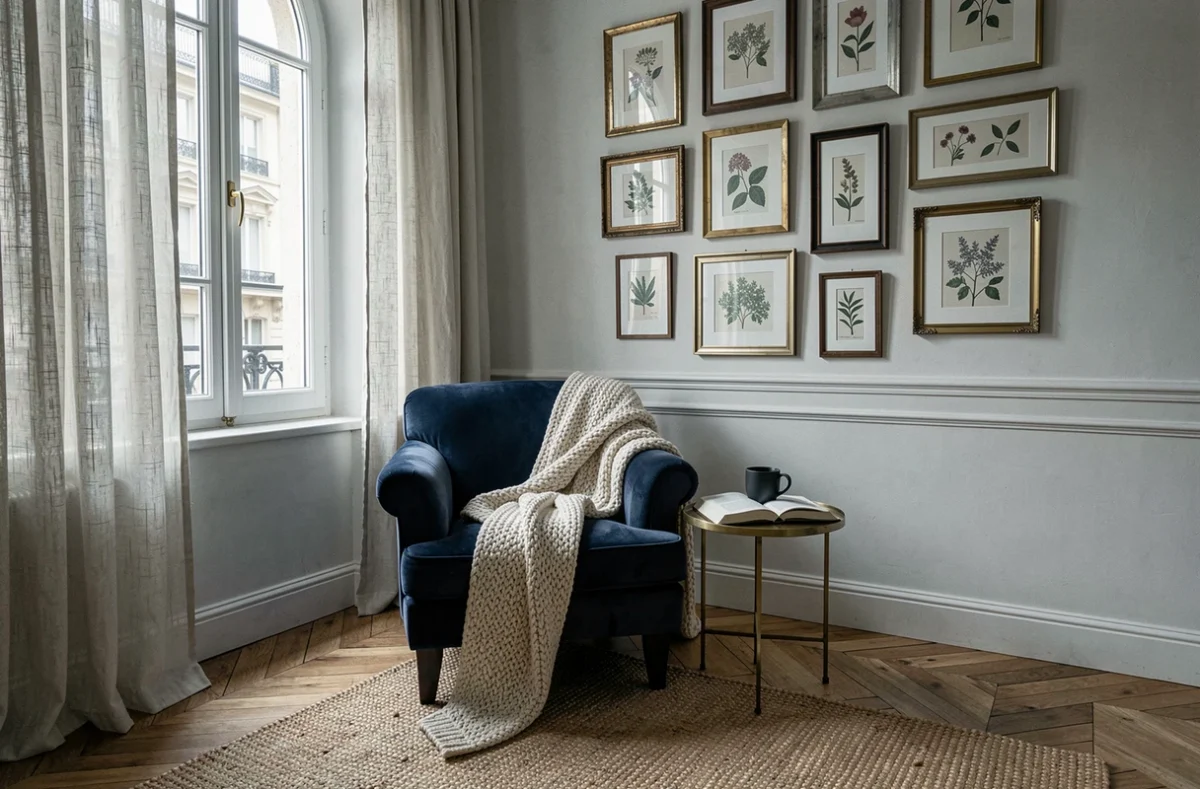
Favor raw linen, certified organic cotton, or non-waterproofed wool. Check that the supplier displays the complete composition of the textile treatment. A fabric labeled Oeko-Tex Standard 100 already excludes most common PFAS.
You will find more decor tips on Brico Déco Home detailing textile finishes compatible with this regulatory transition.
2. Dismantlable and repairable furniture instead of composite furniture
The specifications for 2024-2029 of the French extended producer responsibility scheme for furniture strengthen the goals of repair, reuse, and recycling. In practical terms, a dismantlable piece of furniture can be restored, while a composite piece is thrown away.
Before buying a coffee table or a dresser, check if the joints are screwed or glued. A solid wood top can be sanded and refinished. A laminated melamine panel does not forgive any chipping.
To transform your living room, we recommend focusing on a single structural piece (sideboard, bookshelf, table) rather than multiplying disposable small accessories.
3. Low VOC paint for every room
The quality of indoor air directly depends on wall coverings. Paints rated A+ according to French health labeling emit the least volatile organic compounds. Choosing A+ paint reduces indoor pollutants from the first coat.
An accent wall in a saturated hue (terracotta, duck blue, sage green) transforms a room in just a few hours. The technical tip: apply two crossed coats over a matte white base to ensure pigment depth without excess thickness.
4. Layered lighting: three sources per room minimum
A central ceiling light flattens volumes and creates harsh shadows. The professional rule is to layer three levels of light in each room:
- General indirect lighting (diffusing pendant or LED strip directed towards the ceiling)
- Targeted functional lighting (desk lamp, reading lamp, under-cabinet spotlight)
- Low ambient lighting (table lamp, low-temperature garland, LED candle)
Switching from a single ceiling light to this three-source system radically changes the perception of a living room or bedroom without touching the walls or furniture.
5. Repurposing everyday objects as decor accessories
A raw wooden step ladder becomes a plant shelf. An old carpenter’s ladder, fixed horizontally to the wall, serves as a magazine holder or a suspension for dried herbs. Repurposing works when the object retains its original readability.
The constraint to respect: the repurposed object must fulfill a real function (storage, support, lighting), not just occupy a wall. A purely decorative object without use collects dust and clutters the space.
6. Interior screen to restructure space without partitioning
In a living room open to the kitchen or a large living area, a wooden slatted screen creates a visual separation without blocking light. Vertical slats spaced four to six centimeters apart allow light to pass through while defining areas.
The screen can be fixed between the floor and ceiling or stop at mid-height depending on the desired effect. In natural wood, it can be stained, painted, or left raw. It is one of the most transformative interventions for an open space that lacks structure.
7. Strategic mirrors to correct proportions
A large mirror placed on the floor against a wall visually elongates a narrow room. Positioned facing a window, it doubles the amount of perceived light. A common mistake is to multiply small decorative mirrors: they fragment the reflection and produce the opposite effect.
One large mirror is better than five small frames. Recommended minimum size: half the height of the wall. Favor a thin frame or no frame to increase the reflective surface.
8. Vertical greening with integrated substrate
Plants placed on shelves consume usable surface area. A modular green wall, even a small one, frees up the work surface and adds a dense volume of greenery. Pocket systems made of horticultural felt or recycled plastic cells allow for installation without heavy drilling.
Select species suited to the actual brightness of the room:
- Low light: pothos, Boston fern, peace lily
- Medium light: philodendron, spider plant, ivy
- High light: tradescantia, ceropegia, sedum
A green wall of a few modules is enough to transform a hallway or a corner of the living room into a focal point.
9. Rearranging the living room around a unique focal point
Most living rooms suffer from a layout centered around the television. Moving the sofa to face a fireplace, a wall bookshelf, or a large window changes the dynamics of the entire room.
The principle: every living room needs an architectural focal point, not an electronic one. Identify the most visually interesting element (stone wall, alcove, bay window) and arrange the seating around it. The television can be shifted to a side position or hidden in a closed cabinet.
10. Upcycling and patina of existing furniture
Before buying new, assess what can be transformed on-site. A solid oak sideboard from the 1970s can be modernized with light sanding and a matte oil-wax finish. Controlled patina adds character without erasing the history of the furniture.
The trap: so-called “chalk paint” applied without a primer over existing varnish chips off in a few months. Degrease, sand with 120 grit, apply a bonding primer, then two finishing coats. This protocol applies to wood, metal, and even some rigid plastics.
Each intervention on this list targets a specific lever (light, volume, materials, regulation) rather than a superficial cosmetic change. Start with the one that addresses the most visible constraint in your interior: a dark living room benefits more from lighting work than from a new cushion.